University of Northern British Columbia Apply Today
  INFORMATION FOR:
 INFORMATION ABOUT:
 TOOLS FOR STUDENTS
LOGIN SEARCH CONTACT HOME

About UNBC

  UNBC Coming Events


To add or cancel a listing, please contact the UNBC Office of Communications at (250) 960-5621.

By default only events occurring within the next month are displayed. To broaden or narrow your search to a specific type of event and / or a specific date range please use the filters below. Both the start date and end date are optional for date searches. Ctrl-click (Windows) or Command-Click (Macintosh) to select multiple event types.

Event Type (clear types) Date Range (clear dates)
from
to


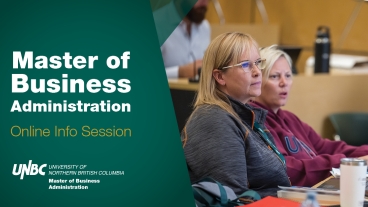
MBA Information Session

Date Wed, March 17, 2010 10:28 am - Wed, March 31, 2010 12:00 am
Location Downtown BMO Centre, 1310-3rd Avenue
Description
March 17, 2010 @ 6:00PM
 
March 31, 2010 @ 6:00PM


Cumulative Environmental Effects and the Tyranny of Small Decisions

Presenter Dr. Bram Noble from the University of Saskatchewan
Sponsor former Northwood Pulp and Timber Limited (now Canfor)
Date Thu, March 18, 2010 7:00 pm
Location Canfor Theatre (6-213)
Description
2010 Natural Resources and Environmental Studies Institute Annual Lecture and Poster Session.  This year's lecture will be given by Dr. Bram Noble from the University of Saskatchewan and is entitled "Cumulative Environmental Effects and the Tyranny of Small Decisions".  The lecture, supported by an endowment from the former Northwood Pulp and Timber Limited (now Canfor) will take place at 7 pm on Thursday March 18th in the Canfor Theatre (6-213). We hope that you can also join us for the poster presentations by current NRES graduate student and NRES Institute members.  A light buffet supper will accompany the poster session in the Atrium of the Administration building beginning at 5 pm.
Please RSVP to Jutta Koehler (email: koehlerj@unbc.ca) before March 12th if you are joining us for supper. I hope to see you there!


Cumulative Environmental Effects and the Tyranny of Small Decisions

Presenter Dr. Brian Noble
Sponsor Former Northwood Pulp and Timber Limited (Now Canfor)
Date Thu, March 18, 2010 7:00 pm
Location Canfor Theatre
Description
You are invited to be our guest at…...
The NRESI Lecture Poster Presentation
Thursday, March 18th, 2010
Please join us for poster presentations where
NRESI members and their graduate students
will present their research in an informal
venue designed to showcase current work.
7:00 pm
Canfor Theatre (6-213)
Conference Centre
For details on viewing a live webcast of Dr. Noble’s talk
please visit http://www.unbc.ca/nres/nresi_webcast.html


Globalization and the Increasingly Unsustainable Entanglement of Nations

Presenter Professor William Rees
Date Fri, March 19, 2010 12:00 pm
Location 6-205 and 211
Description
Professor William Rees will give a presentation entitled "Globalization and the Increasingly Unsustainable Entanglement of Nations" as part of UNBC's Global Fridays speaker series. 


Comfort monitoring? Privatization and environmental assessment follow-up in Saskatchewan's uranium mining industry

Presenter Bram Noble, PhD, Dept. of Geography and Planning, University of Saskatchewan
Sponsor NRESI Colloquium Series
Date Fri, March 19, 2010 3:30 pm
Location Lecture Hall 7-152
Description
Occupying nearly one third of the surface area of the Saskatchewan Shield (100,000 sq km), the Athabasca Basin is one of the world's largest sources of uranium, contributing approximately 22% to global supply.  The Basin is also home to three remote Aboriginal settlements and four small hamlets and communities.  Follow-up and monitoring of the impacts of uranium mining in the Athabasca Basin occurs under two frameworks -- regulatory-based EIA and, more recently, privatized community-industry negotiated environmental agreements.  Negotiated agreements are becoming common-practice in the mining industry, with more than 120 agreements currently established nation-wide.  In principle, negotiated agreements are said to respond to many of the shortcomings of EIA by providing for improved follow-up of project impacts through, among other things, data provision, engaging stakeholders in monitoring and impact management activities, and building capacity at the local level to deal with project-induced environmental change.  In practice, however, little is known about the efficacy of monitoring under negotiated agreements and the demonstrated value-added to project impact management.  This presentation will discuss follow-up practices in the Athabasca uranium mining industry, and examine whether and how monitoring under the negotiated agreement  actually contributes to improved project impact management.  Results will show that follow-up under the agreement is best described as "comfort monitoring".  While such monitoring does improve community-industry relations and enhance corporate image, it does little to support effects-based management.  If monitoring under negotiated agreements is to be credible over the long term, there is a need to ensure that monitoring results are useful for, and integrated with, regulatory-based monitoring and project impact management practices.


Parental Death And Its Health Influence On Orphans in Sub-Saharan Africa: Empirical Evidence From National Household Survey

Presenter Jennifer Crain
Sponsor Thesis Defence
Date Mon, March 22, 2010 9:00 am -
Location Senate Chambers
Description
Ms.Crain is a candidate for the degree of: 
Master of Arts in International Studies
Chair:  Dr. Greg Halseth
Professor, NRES
University of Northern British Columbia


The Role of Molecular Hydrogen in the Physics and Chemistry of the Interstellar Medium

Presenter Dr. Margot E. Mandy, Chemistry Program (UNBC)
Sponsor UNBC Physics Department
Date Thu, March 25, 2010 2:30 pm
Location 5-174 (Library Building)
Description Hydrogen is the most common element in the universe and, in molecular form, it can have a significant influence on physical and chemical processes in the interstellar medium.  Molecular hydrogen is a major constituent of giant molecular clouds.  Shocks in these clouds are associated with star formation.  An understanding of collisional energy transfer processes in molecular hydrogen is essential to the understanding of the relaxation of these interstellar shocks and the associated quadrupole emission spectrum.  Accurate ab initio potentials exist for the interaction of molecular hydrogen with each of atomic hydrogen, atomic helium, and molecular hydrogen.  Detailed state-to-state cross sections and rate co-efficients for energy transfer and state specific values for dissociation of H2 in collision with each of atomic H, atomic D, He, and molecular H2 have been calculated using quasi-classical trajectories.  The similarities and differences in the resulting energy transfer behavior cannot simply be accounted for by whether the collider is open or closed shelled.  These similarities and differences are discussed in terms of the role of certain features of the interaction potential.  In the case of molecular hydrogen as the collider, the role of internal energy in a collider is elucidated, especially with regard to energetic and dynamic thresholds to energy transfer and dissociation.  Comparison of quantum and classical calculations is also considered.    


Changing Climate Change Behaviour: Individual-level Barriers and Solutions

Presenter Dr. Robert Gifford, Professor, Dept. of Psychology, University of Victoria
Sponsor Co-sponsored by Psychology, NRESi and PICS
Date Thu, March 25, 2010 4:00 pm
Location Lecture Hall 6-205
Description
Most people accept that the global climate is changing and understand that their direct and indirect use of fossil fuels will have widespread effects on the environment, which in turn will lead to important impacts on humans.  Nevertheless, polls also report that most people are not prepared to do very much to change their lifestyle.  Why is this?  Why don't our actions match our attitudes?  The choices of some people are hampered by structural barriers beyond their control, but many others are challenged by psychological barriers that can be overcome.  This presentation describes many of these psychological barriers, some evidence about which barriers are most common, and offers potential policy-oriented ideas and solutions for overcoming them.


Alumni Association Board Meeting

Presenter UNBC Alumni Association Board of Directors
Sponsor Alumni Association of UNBC
Date Thu, March 25, 2010 6:00 pm - Thu, March 25, 2010 8:00 pm
Location Prince George Campus ADM 1069
Description
Interested in learning more about the UNBC Alumni Association?  Attend the next  board meeting and find out how you can get involved in our programing and events. To review the last board meeting minutes click here


A Different Way to Teach Programming: Team-Based Learning

Presenter Dr. Patricia Lasserre, Computer Science - Irving K. Barber School of Arts and Science, UBC Okanagan
Sponsor UNBC Computer Science Department
Date Fri, March 26, 2010 1:00 pm
Location 7-152 Lecture Theatre (UNBC)
Description
First year computer science programming has always been a challenge for many students as the course expectation is not only for them to be able to understand programming concepts, but also to produce creative solutions to problems. However, while students may not envision a career in computer science, their first encounter with computer science and programming should still be a positive experience. Several reasons have been identified for the lack of success and the high attrition rate in the first programming class: the perception of the learner about the discipline and his/her attitude (passive or active), the work ethics developed in high school which are different from university, and the lack of practice and feedback with the traditional lecture format are the major factors which seem to impact students’ success. 

Team-based learning (TBL), a teaching technique successfully used in Medicine since the late 80s, exploits the knowledge that the generation Millennium is team-oriented, and very well versed on technology to provide the immediate feedback this generation expects. Indeed, TBL enforces individual accountability, emphasizes team work, and uses any possible method (technological or not) to more actively engage the students in their learning. TBL seemed a natural solution to increase the amount of practice each student will get, and to increase students’ interest and confidence. The initial results of the three years of TBL experimentation suggests that it helps reduce the dropping rate in the class to a reasonable level (10%) and give greater confidence to students in their ability to succeed.

In this talk, we will present TBL, how it has been adapted for our first semester programming class and we discuss the advantages of this techniques and difficulties encountered. Finally we will present the initial results of a 3 year study which analyses students’ success during the final exam using traditional and lecture format and TBL. 


Scripts For Misfits: A Creative Thesis Comprised Of Short Fiction

Presenter Carly Stewart
Sponsor Thesis Defence
Date Fri, March 26, 2010 1:00 pm -
Location Conference Centre 6-307
Description
Ms. Stewart is a candidate for the degree of:
Master of Arts in English Literature
Chair:  Dr. Peter MacMillan
Associate Professor, School of Education
University of Northern British Columbia


Cone and Seed Pests in BC Conifer Seed Orchards: a Research Update

Presenter Ward Strong, BC Ministry of Forests and Range
Sponsor NRESI Colloquium Series
Date Fri, March 26, 2010 3:30 pm
Location Lecture Hall 7-152
Description
BC's conifer seed orchards produce high-quality seed for use in reforestation programs.  A major production obstacle is the depredation of seeds by cone and seed insects.  The BC Ministry of Forests and Range seed pest management research program seeks to resolve ongoing seed loss resulting from intractable pest problems.  Facing the loss of registration of the few insecticides available to orchard managers, we are searching for alternative means of pest management.  In many cases, even the basic biology and taxonomic status of the pests are not clear.  By examining the biological, ecological, and population dynamics processes underlying cone and seed pest problems, we expect to devise novel integrated pest management protocols.  This lecture will discuss the research programs and recent findings for several of our main cone and seed pests.


Production of Medical Isotopes: Thinking Outside the Box

Presenter Dr. Ahmed Hussein, Professor Emeritus (UNBC Physics)
Sponsor UNBC Physics Department
Date Mon, March 29, 2010 3:30 pm
Location 5-171 (Library Building)
Description
The Shutdown of the Chalk River’s NRU reactor created a critical shortage of medical isotopes worldwide.  Other reactors in the Netherlands, Australia, and South Africa are increasing their production but they cannot fully compensate for the shortfall created by the shutdown of NRU.  This talk presents a proposed new method to produce medical isotopes using small and compact particle accelerators that has many advantages over the use of nuclear reactors.


Canadian Wildlife: Where to?

Presenter Dr. Valerius Geist, Professor Emeritus of Environmental Science, Faculty of Environmental Design, Universtiy of Calgary
Sponsor UNBC Fish and Wildlife Student Chapter of TWS in recognition of Dr. Ian McTaggart Cowan's 100th Birthday
Date Tue, March 30, 2010 7:00 pm
Location Lecture Hall 7-212
Description
The history of wildlife conservation in the West is long and deeply troubled.  Normally, wildlife was the possession of the ruling elite subject to conspicuous consumption, and maintained brazenly and ruthlessly against the interest of common people.  It was a universal symbol of the hated elite and was destroyed in rebellions and uprisings.  The link of wildlife and elitism, despite dedicated efforts to change such in modern times in Europe, has never entirely succeeded.  This makes the North American Model of Wildlife Conservation the more remarkable.  It arose about a century ago out of the sorry consequences of letting Garret Harding's Tragedy of the Commons run its full course, virtually destroying wildlife continent wide.  A white collared elite from Canada and the United States joined hands to rescue wildlife, and succeeded in that task via a unique system of wildlife conservation.  It is so unique and so successful that it has been proposed for global application.  This system and our wildlife have been attacked, however, by various groups and the question is now if this model will survive, or whether wildlife will revert to private ownership to be ruthlessly exploited by a segment of our elite for its pleasure, frivolous pleasures, I might add, by an elite that believes in entitlement.  A number of dangers come from people of infinite good will but myopic policies.  There are also severe dangers in the success of the North American model, especially to public health.  Much is in need of re-examination, a prerequisite to any effort to plan a rational future for wildlife.


MBA Project Defences

Presenter MBA Students
Date Wed, March 31, 2010 9:51 am - Thu, April 01, 2010 12:00 am
Location 10-4068
Description
March 31, 2010
1:00PM:  Angie Horianopoluous
2:30PM: Carl Overennay
3:30PM: Wendy Rogers

April 1:
3:00PM: Nathan Lauer
4:00PM: Mohammed Ghane
5:00PM: Keila Barbosa
6:00PM: Barnard Foo


In Singing, He Composed A Song

Presenter Jeremy Stewart
Sponsor Thesis Defence
Date Wed, March 31, 2010 1:00 pm -
Location Teaching and Learning Bldg 10-1504
Description
Mr. Stewart is a candidate for the degree of:
Master of Arts in English
Chair: Greg Halseth
Professor, NRES
University of Northern British Columbia


Initial Investigation Into Using Two-Level Regional Voting Approach For Face Verification

Presenter Jun Ma
Sponsor Thesis Defence
Date Tue, April 06, 2010 2:00 pm -
Location Senate Chambers
Description
Ms. Ma is a candidate for the degree of:
Master of Science in Mathematical, Computer, and Physical Sciences (Computer Science)
Chair:  Dr. Martha MacLeod
Professor, Community Health Sciences
University of Northern British Columbia


6th Annual Dr. Bob Ewert Memorial Lecture

Date Sat, April 10, 2010 5:30 pm
Location Prince George Civic Centre
Description The 6th Annual Dr. Bob Ewert Memorial Lecture will be on April 10 at the Prince George Civic Centre. The keynote speaker will be renowned actor Charles Keating, who will give a presention entitled "I and I: The Sense of Self (A Monologue on Aging)".
 
This event is in support of the Northern Medical Programs Trust and the Ewert Memorial Medical Lecture Fund.


6th Annual Dr. Bob Ewert Memorial Lecture

Presenter Charles Keating
Date Sat, April 10, 2010 5:30 pm
Location Prince George Civic Centre
Description
Support our future health care professionals! The Northern Medical Society and UNBC invite you to the 6th Annual Dr. Bob Ewert Memorial Lecture and Dinner in support of the Northern Medical Programs Trust.
 
Speaker: Actor Charles Keating
Monologue on Aging: "I and I: The Sense of Self"
 
Tickets are $100 with a portion eligible for a charitable receipt issued by UNBC. Reservations by table (parties of 10) are encouraged. Otherwise, seating will be assigned.
 
For tickets contact the UNBC Office of External Relations:
Phone: 250-960-5750 or 1-866-960-5750
Email: advancement@unbc.ca
 

University of Northern British Columbia
3333 University Way, Prince George, BC, Canada, V2N 4Z9   |  Website Feedback  |  Contact Security