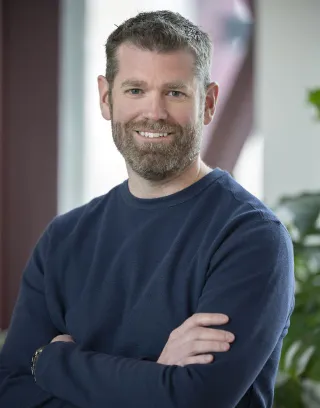
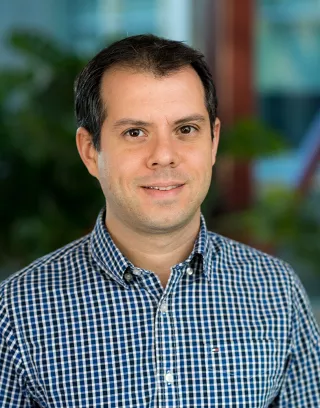
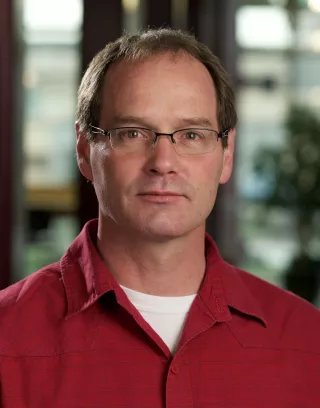
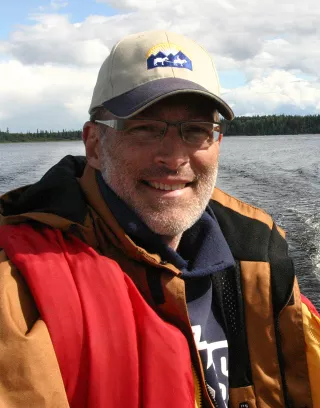
Dr. Lewis is a forest pathologist/microbial ecologist with research interests in the role of pathogenic fungi in natural ecosystem processes, and the long term effects of forest practices on forest health. In particular Kathy studies the relationship between biotic disturbance agents and stand dynamics, and the population genetics of forest pathogens as influenced by forest management practices.
Dr. Shrimpton earned his Phd from the University of British Columbia. He has interests in the physiological response of fish to environmental disturbance, particularly how physical changes in the environment affect endocrine, biochemical, physiological and molecular factors that regulate growth and development in fish.
Dr. Booth received a doctorate in environmental ethics from the University of Wisconsin-Madison and a Masters in environmental policy at York University. Her research interests included Environmental and Natural Resources Policy (Domestic and International); Environmental Philosophy and Ethics; Native American/First Nations Worldviews; Women and Environments; Sustainable Development and Communities; Community Based Resource Management; Environmental Education.
A major research interest of Dr. Coxson is studying the diverse contribution of non-vascular plants, such as lichens and mosses, to ecosystem function along elevational gradients in
Western Canada
. This research draws on experimental approaches from many fields; including lichenology, plant environmental physiology, forest ecology, and conservation biology. These approaches are now being applied by Dr. Coxson and his students in the study of canopy epiphyte communities from inland wet-temperate rainforests in
British Columbia
, where they have been examining the potential use of canopy lichens as indicators of forest health and ecosystem change.
Dr. Dawson is an avian ecologist whose interests include determining the important proximate and ultimate factors influencing reproductive effort and success in birds. Specific areas of interest include mate choice, sexual selection, parasitology, and the mediating role that variation in environmental conditions has for the evolution of life-history traits. He holds a PhD from the University of Saskatchewan.
Dr. Egger, who obtained his PhD from the University of Victoria, uses molecular approaches to study microbial ecology, biodiversity and phylogeny. His research is focused on the link between biodiversity and ecosystem function, particularly mycorrhizal fungi and microbes involved in nitrogen cycling. He has research projects underway on impacts of fire on mycorrhizal communities in boreal forest and on impacts of global warming on microbial communities in the arctic.
Dr. Fredeen is a forest ecophysiologist. Primary research interests include the measurement of CO2 fluxes into and out of forests, logged areas and pastures in central British Columbia using Bowen Ratio and Eddy Covariance approaches. Other research interests include impact of forest management on carbon stocks & fluxes; sub-boreal forest bryophyte and lichen diversity & function.
Dr. Garcia is the West Fraser Endowed Chair in Forest Growth and Yield. Oscar's research addresses “Quantitative forestry”,including growth modeling, biometrics, mensuration, harvest scheduling, decision support systems.
Dr. Gillingham has broad interests in population and wildlife ecology, modeling, plant-herbivore interactions, and behavioural ecology. He received his PhD from the University of British Columbia.
Dr. Green is a forest ecologist with a background in tree physiology. His research activities focus on tree/ecosystem adaptive responses to environmental variation. He has a particular interest in the responses of northern and high-elevation forests to climate change.
Dr. Hartley's research interest is in wood quality (ultra-structure and anatomy) and wood physics (wood-water interactions, diffusion, sorption, lumber drying and NMR) pertaining to forest products issues for Northern British Columbia. He has a keen interest in examining wood properties based on wood characteristics and how it pertains to processing issues.
Dr. Hawkins' general research interests are forest productivity, ecology, silviculture and management. Topics he is currently investigating include management of mixedwoods, economic impacts of silviculture decisions, and the genecology of paper birch and trembling aspen.
Dr. Huber's research is focused on insect/plant interactions, plant defense against insect herbivory, insect resistance to plant defenses, chemical ecology, forest insect pest managment. He is particularily interested in molecular biological aspects of these subjects.
Dr. Johnson's research integrates the disciplines of wildlife, landscape, and conservation ecology to plan for and mitigate the influences of human developments on the environment. Typically working at broad spatial scales using GIS, remotely sensed data, and advanced statistical models, Chris also has an appreciation for field investigations and multiscale phenomena. Current research themes include cumulative impacts of resource development on Arctic wildlife, assessment of species-distribution models, and community-based conservation monitoring and planning.
Dr Lindgren's area of interest is forest insect ecology and management. His current research activities involve forest insects and their role or impact on stand or landscape level processes, biodiversity, and host selection mechanisms.
Dr. López-Gutiérrez is a soil microbial ecologist interested in understanding how the microbial interactions occurring in the rhizosphere, i.e. zone of direct influence of plant roots, affect decomposition and nutrient cycling in soil. Using molecular techniques, along with more traditional soil chemical and biochemical approaches, Juan Carlos monitors rhizopheric community structure including changes in particular fungal and bacterial functional groups that play key roles in nutrient cycling and ecosystem function.
Dr. Manuel earned her Ph.D. from Dalhousie University.
Dr. Manuel’s research interests are in the field of larval biology, in particular the vertical migration behavior of both vertebrate and invertebrate larvae, which is fundamental to the dispersal/retention of aquatic larvae. Her papers have focused on rhythmic changes in behavior in response to discontinuities in water density due to differences in salinity and/or temperature. She is exploring the possibility that adaptations to local hydrographic conditions play a role in creating discrete populations within aquatic species.
Dr. Massicotte's research interests include the structure and biodiversity of mycorrhizae, tree and rhizosphere biology, and forest mycology. He has published extensively in a number of international scientific journals.
Dr. Migabo obtained her PHD from Cornell University. Her research interest includes wildlife-habitat interactions, wildlife productivity, tropical ecology and rare and endangered plants, animals and ecosystems.
Dr. Murray's research revolves around three central themes: molecular ecology (conservation genetics), molecular evolution and comparative immunogenetics. This research focuses on the characterisation, organisation and evolution of genetic variation at both neutral (e.g. mitochondrial) and selected loci, with particular emphasis on the immune system genes (i.e. MHC) in aquatic vertebrates (marine mammals and bony fishes) and their use in population level surveys of genetic variation.
Dr. Opio's research interests include forest management and policy, silviculture, environmental aspects of harvesting systems, land reclamation, woodlot management, tropical forestry and agroforestry.
Dr. Otter's research addresses how habitat disturbance affects both reproductive and communication behaviour in forest birds. Using a combination of ecological, genetic and behavioural techniques, he and his students are interested in the impact of habitat on signal reliability, mating strategies and ultimately reproductive output of forest generalist birds occupying postdisturbance landscapes. Ken received his PhD from Queen's University.
Dr. Parker's research interests include bioenergetic strategies of wildlife and the trade-off decisions for survival, plant-herbivore interactions, and the contribution of individual animal requirements within large-scale ecosystem processes.
Roy Rea's research interests include plant-animal interactions, mitigation of ungulate-vehicle encounters through habitat manipulation, considerations for critical habitat features in forest management and planning and science education through research.
After 11 years as a regional soil scientist in the BC Ministry of Forests, Dr. Sanborn joined UNBC in 2002. His research program builds on established local field studies of site productivity, nutrient cycling, and soil rehabilitation, and is developing a new emphasis on the role of soils as a recorder of long-term environmental change in northwestern Canada.
Dr. Young has research interests in ethnobotany (particularly medicinal uses of plants), organic fertilizers and plant growth, and plant adaptation in aquatic ecosystems. She received her Ph.D. from the University of Toronto.
Dr. Aukema's research interests include the population ecology of bark beetles, plant-insect and predator-prey interactions, and the application of statistical tools to novel ecological questions therein. An overarching interest in landscape ecology includes linking patterns across space and through time to community-level processes.
Dr. Burton is interested in disturbance ecology, germination ecology, seed dispersal, plant competition, forest regeneration, stand development and succession. He has researched silvicultural systems, forest restoration, old-growth dynamics, stand edge effects, and the ecology of understory shrubs. His current work explores the disturbance ecology of northern B.C. and the dynamics of stands attacked by mountain pine beetle.
Adjunct Faculty
Dr. Allan L. Carroll
Adjunct Professor
Associate Professor
Department of Forest Sciences
Faculty of Forestry
University of British Columbia
3034 - 2424 Main Mall
Vancouver, BC V6T 1Z4
Canada
Phone: (604) 822-3360
Fax: (604) 822-9102
Allan.Carroll@unbc.ca
Dr. John J. Clague
Adjunct Professor
Shrum Research Professor
CRC Chair in Natural Hazard Research
Department of Earth Sciences
Simon Fraser University
Elena has a Doctor of Veterinary Medicine (Western College of Veterinary Medicine), a Diploma in International Animal Health (University of Edinburgh, Centre for Tropical Animal Diseases) and is in her final year of a research MSc (University of Edinburgh, Centre for Tropical Animal Diseases). Her research interests are in disease ecology existing at the interfaces between domestic animals (companion and rural), humans and wildlife. She is currently working as the Veterinarians Without Borders- Canada Program Leader in Chile, developing long- term sustainable programs addressing the complex issue of domestic dog overpopulation, and the multiple urban, rural and wild habitat health effects resulting from these uncontrolled populations.
Dr. Marten Geertsema
Adjunct Professor
Ministry of Forests and Range
1011 - 4th Avenue
Prince George, BC V2L 3H9
Canada
Phone: (250)565-6923
Fax: (250) 565-6671 Marten.Geertsema@gov.bc.ca Dr. Geertsema's primary study focus is on natural hazards and terrain analysis. He is interested in the influence of landslides on biophysical diversity. He is also interested in the effects of climate change on natural hazards, and therefore studies past and present hazard regimes.
Mr. Doug Heard
Adjunct Professor
Ministry of Water, Land and Air Protection
4051 - 18th Avenue
Prince George, BC V2N 1B3
Canada
Phone: (250) 614-9903
Doug Heard' s research interests centre on the effect of predation risk from wolves and bears on the distribution, abundance and management of caribou, moose and mountain goats.
Dr. Lohrasebi is interested in research with industrial applications, including OSB process improvement / optimization, chemistry of chemical pulping and bleaching, kraft pulpmill effluent treatment, and chemical characterization of lignocellulosic materials for bioenergy.
He has a Bachelor of Engineering from Iran, MScF from the University of Toronto and PhD from the University of British Columbia. As an assistant professor, Hossein taught and supervised students at the University of Tehran, and conducted R&D at UBC and Forintek. For the past few years, he has been working in the forest products industry (OSB, Kraft Pulping, and Environmental Sectors).
Dan has a PhD in Forest Science (specializing in Cultural Anthropology, Rural Sociology, and Traditional Agroforestry Systems) from the Forestry Studies Centre–University of Pinar del Rio, Cuba (2005). His research interests are traditional ecological knowledge, agroforestry, ethnobotany, qualitative analysis, sociological theory and the environment and cultural studies. As Adjunct/Honorary Associate Professor, his role is to guide graduate students, industry, private and public firms and organizations in socio-economics extension services and on-the-ground capacity building for clients and partners in the Northern Interior of BC, and ensure practitioner needs are addressed through accessing human-environment research of natural resource management. His interests are also technical guidance on program plans and strategies. Dan is fluent in Spanish and has a working knowledge of French and Portuguese.
Ms. Stevenson is interested in the effects of forestry practices on biodiversity and wildlife habitat. She is especially interested in wildlife that depend on habitat attributes found in old forests, and how these species can be maintained in managed landscapes. Recent studies have focussed on effects of partial cutting on mountain caribou habitat, on arboreal lichens, and on wildlife tree-dependent species.
Dr. Kimberly F. Wallin
Adjunct Professor Research Assistant Professor
University of Vermont
Rubenstein School of Environment and Natural Resources