
UNBC to Lead New Western Canada Glacier Research Network
May 23, 2006
One of the defining characteristics of Western Canada’s geography isthe subject of a new research network based at the University ofNorthern British Columbia (UNBC). The five-year study announced todaywill help increase understanding of how glaciers will react to futureclimate change.
Glaciers cover 100,000 square kilometres in BC – 10% of the province’sland mass. They serve as frozen reservoirs of water that nourish lakesand rivers during the late summer and fall when runoff from seasonalsnow cover is depleted. Glaciers are also important to people living inwestern Canada since approximately 90% of BC’s electricity is generatedfrom melting snow and ice. Glaciers attract thousands of visitors to BCand Alberta mountain parks every year.
“The University of Northern British Columbia is the ideal institutionto study how glaciers will continue to shape Canada’s environment andeconomy in the future,” said the Hon. Jay Hill, Member of Parliamentfor Prince George-Peace River. "I am proud of the importantresearch undertaken by UNBC with the support of the FederalGovernment."
“There is an urgent need for this research,” says Brian Menounos, afaculty member at UNBC. “Over the last 150 years, western Canada haswarmed more than anywhere else in the globe outside of the very highlatitudes.” Dr. Menounos is leading the Western Canadian CryosphericNetwork (WC2N), a new research network that is receiving $2.1 millionin funding from the Canadian Foundation for Climate and AtmosphericSciences (CFCAS). Other participating institutions include theUniversity of British Columbia, Simon Fraser University, University ofAlberta, University of Calgary, University of Victoria, University ofWashington, federal and provincial governments, BC Hydro, Natural Resources Canada, and theColumbia Basin Trust.
By working together over the next five years, WC2N aims to understandthe links between climate variability and glacier fluctuations inBritish Columbia and western Alberta. Research will be conducted onglaciers in the Coast, Columbia, Selkirk, Cariboo, and Rocky Mountainranges to detail how glacier extent has changed over the past 400years. This information will be used to better understand climatevariability and how glaciers will respond to projected climate changeover the next 50 to 150 years.
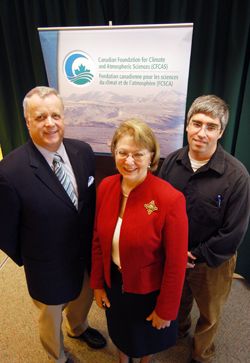
Caption for photo: Memberof Parliament Jay Hill (left) joins CFCAS Executive Director DawnConway and researcher Brian Menounos at the announcement of the WesternCanadian Cryospheric Research Network.
Contact:
Brian Menounos, Geography professor, UNBC - 250.960.6266
Rob van Adrichem, Director of Media and Public Relations, UNBC - 250.960.5622