
Fill out the Post campaign survey now!
The Energy Wise Network
UNBC is a proud member of BC Hydro’s Energy Wise Network, a community of sustainability leaders committed to engaging their organizations in reducing energy consumption and using resources responsibly.
As an Energy Wise Network member, UNBC benefits from training, networking opportunities, campaign tool-kits, personalized coaching, and incentive funding to implement an annual energy saving campaign on campus.
Energy Wise Campaign 2026 - Campus Battle: Save the Watts!
This year, the Energy Wise Network campaign features a friendly electricity reduction competition between the UNBC Main Campus and UNBC Residences from February 2 to 27. The aim is to inspire small, simple changes that build long-lasting energy saving habits while fostering sustainability awareness across the university.
Electricity use will be monitored each week to track progress. Students, staff, and faculty are invited to participate by making energy conscious choices wherever they study, work, or live.
How to Participate
- Complete the pre-campaign and post-campaign surveys to enter the survey prize draw.
- Adopt energy saving habits throughout February.
- Share your actions with others and encourage your friends or coworkers to join in.
- Post a picture of yourself doing an energy saving action and tag @unbcsustainability to be entered into the social media draw.
- Get bonus points for tagging your friends!
Prizes
- The grand prize, a digital piano, will be awarded to the building that reduces the most electricity during the campaign!
- A prize draw will be held for participants who complete the surveys.
- A prize draw will be held for participants who share posts about their energy saving actions and tag UNBC Sustainability.
- Additional small prizes may be offered throughout the campaign to keep the challenge fun and engaging.
Energy Saving Actions
This year there are no weekly themes. Instead, participants can choose from a list of simple actions that can be done anywhere on campus or in residence.
Lighting and Natural Light
- Turn off lights when you leave a room. Lighting accounts for approximately 15% of electricity consumption on university campuses.
- Open blinds to make use of natural light. It is brighter, free, and usually kinder on the eyes.
Electronics and Devices
- Let your computer screen sleep rather than using a screen saver. Screen savers use just as much energy as an active screen.
- Switch devices to power saving mode. Many use around 70% less energy this way.
- Unplug chargers once your phone or laptop is full. They keep drawing energy even when the battery is done.
Heating and Thermostats
- Keep furniture away from heaters or vents so warm air can move around properly.
- Make sure windows are closed when the heat is on.
- If you can adjust your thermostat, try setting it slightly lower and throw on a sweater. Comfort often starts at 20°C, not 25°C.
Hot Water and Appliances
- Wash laundry in cold water. About 90% of a washer’s energy goes toward heating water, not cleaning clothes.
- Take shorter showers. Less time thinking about life decisions, more time saving energy.
Powering Down
- Turn off computers, monitors, and lights before leaving for the day.
- Power down shared equipment like printers or kettles when they are not needed.
Our Previous Campaigns
Our Previous Campaigns
2025 Battle of the Buildings: Energy Savings
In 2025, the campaign will be focused on energy savings between the two UNBC Residence buildings Neyoh and Keyoh as part of the UNBC Residence Building Challenge.
The UNBC Residence Building Challenge encourages students in the two campus residence buildings to reduce energy consumption during a four-week residence building challenge from February 2–28, 2025. The campaign aims to inspire energy-saving behaviours related to space and water heating and lighting while fostering sustainability awareness, fun, and friendly competition. Students can win prizes, including a grand prize of a ping pong table for their lounge, and earn points toward the UNBC Residence Cup.
Participants will take a pledge and complete surveys at the start and end of the challenge to measure behaviour changes and lessons learned. Energy use in the two buildings will be tracked throughout the campaign to determine the winner. Results and progress will be shared weekly to build momentum, with a celebration and prizes awarded at the conclusion.
Ways you can win
- Pledge to continue to commit to energy-saving actions by filling out our post-campaign survey: https://www.surveymonkey.ca/r/C3QYTHX
- Commit to Energy Saving Actions during the campaign and beyond! (check your door hangers for more info)
- Post on Social Media a picture of yourself performing an energy-saving action for that week and tag @unbcsustainability
- Get bonus points for tagging your friends!
Prizes
- The grand prize—a Ping Pong table—will be awarded to the residence that saves the most energy during the campaign! At the end of the initiative, Sahil Dino, the energy manager, will calculate the results.
- A reward for the building with the highest number of pledges.
- A prize draw for participants who shared posts about the campaign and tagged us on social media.
- Gift card draw for those who filled out the pre- and post- campaign surveys
Week 1 focus (Feb 3 - 8)
Turn off the lights / unplug your devices when not in use or fully charged.
- Lighting accounts for approximately 15% of electricity consumption on university campuses. By consistently turning off lights when leaving a room, students can significantly reduce this energy usage. Source
Week 2 focus (Feb 9 - 15)
Take shorter showers / do laundry in cold water.
- Taking shorter showers can cut carbon emissions.
- Showers are often: 5% washing, 10% singing, 85% making life decisions. Just do the washing (and maybe the singing).
- About 90% of the energy used by the washing machine during laundry goes towards heating the water.
Week 3 focus (over Reading Week - Feb 16 - 22)
Turn down the thermostat / put on a sweater.
- Save energy and reduce carbon emissions by programming your thermostat to 16°C when you're sleeping or away from home (the II setting on the radiator knob), and 20°C (the III setting on the radiator knob) when you're at home and awake. Wear a sweater if you're cold
Week 4 focus (Feb 23 - Feb 28)
Maximize your impact with all these actions and more!
- Want to win a ping pong table for your residence? Maximize your impact with all three energy-saving strategies!
The Winner is: NEYOH!
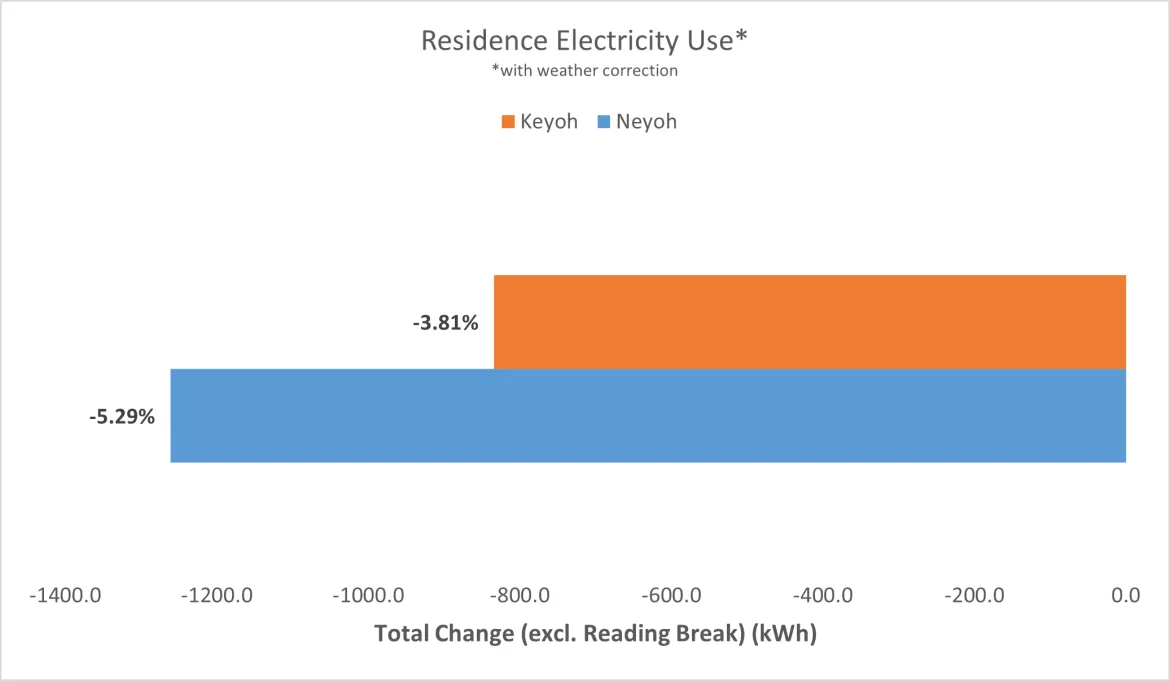
Both buildings saw a decrease in electricity usage, with an average reduction of about 4.5%, totaling over 2,000 kWh – enough to fully charge our Nissan Leaf around 50 times. Reading break data was excluded because many students were away, which skewed the results.
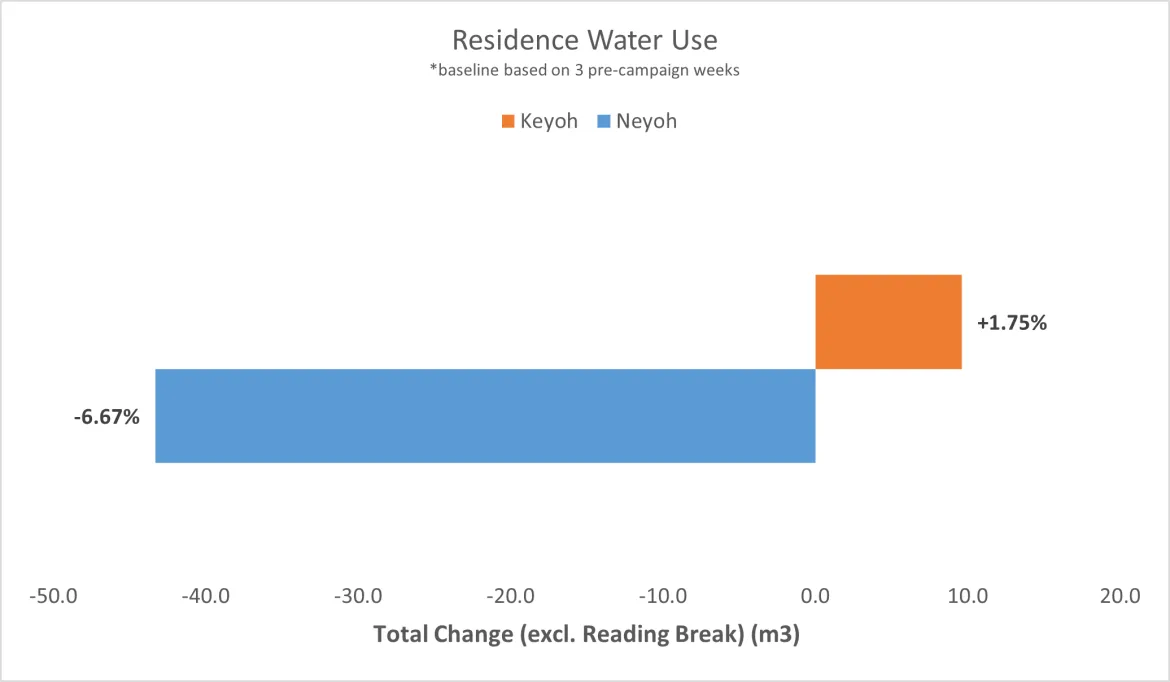
Neyoh achieved reductions in water usage, while Keyoh experienced a small increase in water consumption. Reading break data was excluded because many students were away, which skewed the results.