
|
|
About the UNBC Region
Introduction
Northwest Region
Peace River-Liard Region
South-Central Region
Introduction
UNBC serves the northern two-thirds of British Columbia. This area is divided into three regions: the South-Central, the Peace River-Liard, and the Northwest.
The university presently has four main campuses: Prince George,
Terrace, Quesnel, and Fort St. John. Teaching centres are also found in
Prince Rupert, the Nass Valley, Williams Lake, Dawson Creek, Chetwynd,
Fort Nelson, and Tumbler Ridge, among others. Check the course offerings page for a complete list of locations. Prospective students should contact the nearest regional campus for information on how they may access our courses in their community.
Northwest Region
UNBC's Northwest Campus is located in Terrace. UNBC also maintains a presence at the Prince Rupert campus of Northwest Community College.
The Northwest Region for UNBC is the area served by Northwest Community College. From Houston to Haida Gwaii, the communities of the Northwest are eager to work with UNBC.
The
Northwest Region has been the homeland since time immemorial of the
Northwest Coast First Nations: the Wet'suwet'en, Gitksan, Haisla,
Nisga'a, Tsimshian and Haida. These nations still comprise over 25% of
the population of the region and their communities are growing. There
are now over seventy thousand people living in several dozen
communities in the region: (roughly from east to west) Houston, Telkwa,
Smithers, Moricetown, the Hazeltons (including Gitanmaax), Gitwangak,
Gitanyow, Kitsegukla, Stewart, Terrace, Kitamaat Village, Kitimat, Kitselas, Kitsumkalum, Port
Edward, Prince Rupert, Metlakatla, Lax Kw'alaams, Hartley Bay,
Kitkatla, Sandspit, Queen Charlotte City, Skidegate, Tlell, Port
Clements, Masset and Old Masset. The four communities of the Nass
Valley (Gingolx [Kincolith], Lakalzap [Greenville], Gitwinksihlkw
[Canyon City], and Gitlakdamiks [New Aiyansh]) on the northernmost
coast are served by the Wilp Wilxo'oskwhl Nisga'a, which has a partnership with UNBC.
The
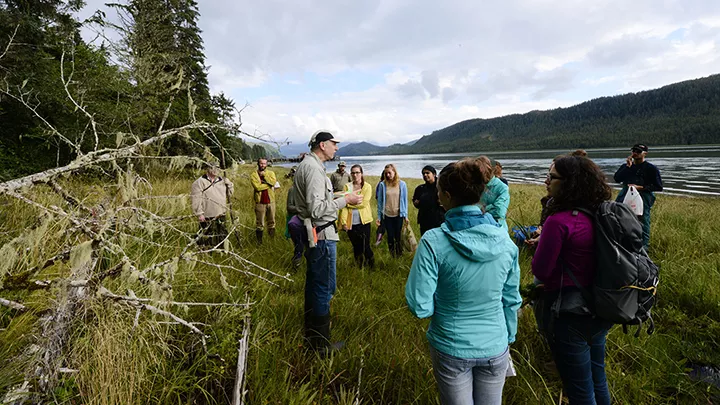
Northwest is an area of stunning beauty visited by almost half a
million tourists each year. The scenery they enjoy here ranges from
interior farming valleys to coastal fjords-- interspersed with craggy
mountains and lava flows that still resist the incursion of vegetation.
The outstanding recreational opportunities offered in the region
include hiking, fishing, whale-watching, rock-climbing, skiing and
visiting such venues as 'Ksan and Pike Island, which feature the rich
heritage of the First Nations of the Northwest.
The Northwest
Region is prime habitat for wildlife. A few species, such as the
Kermode bear (a non-albino white variety of black bear), are unique to
the area. Some of the more common wildlife species include moose, black
bear, grizzly bear, wolves, lynx, elk, deer, dall sheep, mountain goat,
beaver, muskrats, ducks, swans, geese and many other species of birds
such as owls, ravens and eagles. The rivers of the region are among the
most productive salmon streams in the world, and the coastal waters
yield halibut, cod, crab, octopus and shellfish from the intertidal
zones.
The climate of Haida Gwaii and the North Coast is
tempered by the ocean, but on the landward side of the Coast Mountains
the weather is characteristically continental, with cold winters and
warm summers. This region abuts the Alaska Panhandle, and in summer the
daylight lasts from 4:00 a.m. until after 11:00 p.m.
The economy
of the Northwest has developed into a complex system over the past
century though it still relies on resource extraction, freighting,
government services, and retail trade and service delivery. In the
decades since World War II the Northwest has experienced both boom and
bust. A sustainable economic future is the goal of all the communities
in the region. The increase in available local capital that will follow
the settlement of the long-standing First Nations land rights cases may
be an important economic stimulus for the entire region.
Northwest Region - Community Profiles
Peace River - Liard Region
UNBC's Peace River-Liard Campus is located at the Fort St. John partnership campus of Northern Lights College.
Located
at the edge of the Great Northern Plain, the Peace River-Liard Region
is vast. It includes all of Northeastern British Columbia, which
constitutes approximately one-fifth of the total landmass of the
province (46,000 square miles or 12 million hectares). This is
equivalent to the size of Great Britain.
The topography varies
immensely in this region from the Rocky Mountains in the West to the
Interior Plains in the Eastern sections. More specifically, the terrain
changes from a prairie environment of the Peace River country to the
boreal forests of Fort Nelson and the mountain valleys of Iskut and
Atlin.
In short, this is a country of big skies, expansive
horizons, wild valleys, mountains, muskeg and rivers. Some of the
better-known rivers of this region include the Peace, Beatton, Fort
Nelson, Pine, Moberly, Sikanni, Halfway, Prophet, Ominica, Muskwa and
the Fontas.
The Peace River-Liard Region hosts an immense
variety of wildlife and is home to the largest and most diverse
ungulate population in North America. Some of the more common wildlife
species include moose, black bear, grizzly bear, wolves, caribou, elk,
mule and white tail deer, stone sheep, mountain goats, beavers,
muskrats, ducks, swans, geese and many other species of birds such as
owls, eagles and other raptors. The incredible abundance of wildlife in
this area has led some naturalists to describe it as the "Serengeti of
the North". The fish population is also quite diverse and includes
rainbow trout, lake char, dolly varden, arctic grayling, whitefish,
burbot, northern pike and perch. This region does not have a salmon
population, which distinguishes it from every other part of British
Columbia. The size and diversity of Northeastern BC's wildlife and fish
population is matched only by the numbers and dimensions of its
mosquitoes and blackflies. The climate of this region is continental,
being characterized by beautiful and hot summers where the sun rises at
4:00 am and sets by 11:00 pm, and by winter where temperatures can drop
below -50 degrees Celsius. While the winters can be long, the region is
usually blessed with blue skies and sunny days even though the
temperatures may be quite low.
South-Central Region
UNBC's South-Central Regional Office is located at the Quesnel partnership campus with the College of New Caledonia. We also work in cooperation with the regional campus of the University College of the Cariboo in Williams Lake.
Our
South-Central Campus in Quesnel serves an area that stretches from 100
Mile House to Valemount to Burns Lake. Full degree programs available
in Quesnel include a Bachelor of Social Work, a Bachelor of Arts
(General and English and History majors) and a Bachelor of Science in
Nursing, a collaboration with the College of New Caledonia. Special
courses have included Local History in Barkerville and Creative Writing
in Wells and Quesnel, and cohort-based graduate degree programs such as
the Master of Education. In future we expect to offer locally the
Master of Social Work and the Master of Science in Community Health.
In
Williams Lake the Weekend University is delivered in partnership with
the Cariboo Tribal Council and the University College of the Cariboo.
It offers university-level courses, certificates, associate of arts
degrees and Bachelor's degrees through coursework on alternate weekends
to mature students throughout the Cariboo and Chilcotin. Open to
anyone, these courses appeal particularly to working First Nations who
wish to remain in the their communities while still participating in
post-secondary education.
The South Central Region - Community Profiles
|
 |